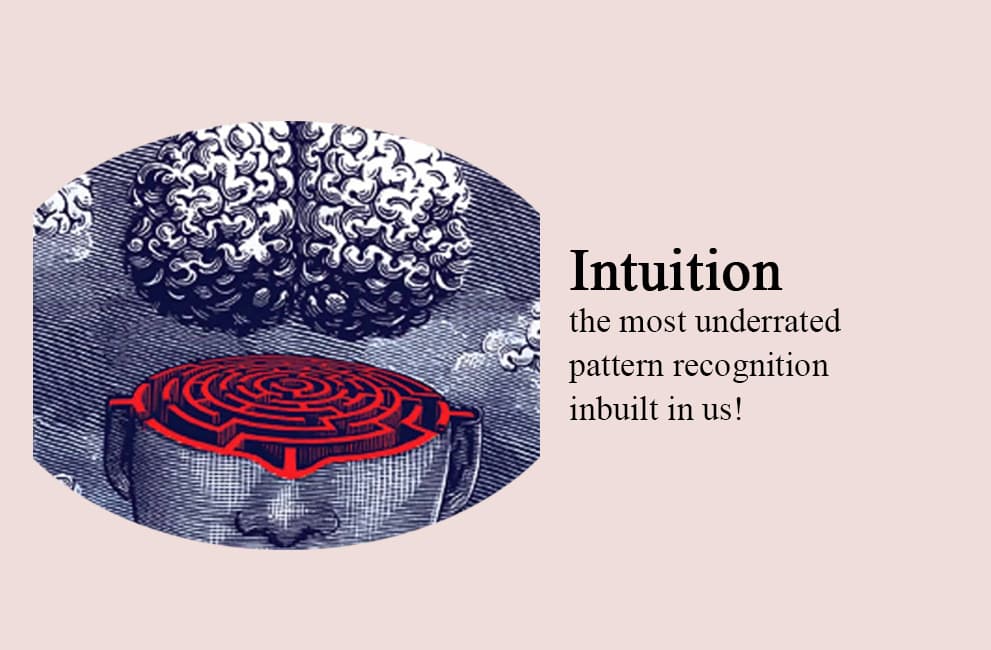
Intuition — the most underrated pattern-recognition machine we have
At a time when data is the king and pivotal to every decision, talking about intuition or gut-feel sounds horse-and-buggy. Equipped with technology that generates terabytes of data a day, this hyper-connected world easily overshadows the technology that's inbuilt in us. Humans are the best pattern recognition machines — that's the quality we call intuition.
I've lost count of the times I've done some deep analysis on a problem, all hard numbers and figures, and then someone walks by, glances at it, and says — hey, this sounds kinda off — and it turns out it indeed was.
Intuition.
It is ironic that despite this being a powerful ability, it is rarely talked about, thought about, or nurtured. The reason is probably its abstract nature. Many people use the word "intuition" loosely while making decisions, without much evidence for the unconscious work the brain or body is doing. Even more ironic is that a person who is intuitively sharp is often evaluated negatively against their more analytical counterpart — a kind of Cornelian dilemma.
We are designed to see patterns. The brain processes information as it comes in, but it also accumulates the learnings and insights from past experiences — forever. Intuition is the layer that leverages this almost-unconscious big-data warehouse to make decisions going forward. Analogically: intuitive decisions are themselves based on data.
The right framing isn't intuition vs. data. It's both, used together.
A useful frame for this is Charlie Munger's idea of mental models — the latticework of ideas you carry in your head:
"What is elementary, worldly wisdom? Well, the first rule is that you can't really know anything if you just remember isolated facts and try and bang 'em back. If the facts don't hang together on a latticework of theory, you don't have them in a usable form."
"You've got to have models in your head. And you've got to array your experience — both vicarious and direct — on this latticework of models."
Note the word latticework — the interconnected nature of models in the mind.
Culturally we've been taught to be rational when making decisions about anything from complex business choices to what to wear today. Intuition gets the back seat. The most powerful decision-making ability arrives when one has nurtured the ability to unconsciously amalgamate intuition with data, fitting both onto the mental models that already exist deep within.
Data versus intuition is worthless
Decisions made on intuition alone fail because that one-sided approach overlooks the details — and the devil lives there. Decisions made on data alone — which is almost always limited in scope and degrees of freedom — often overlook the abstract, unfolding story behind. Leverage data inside the latticework of mental models, and build a relationship between the two — mentally. That is the move.