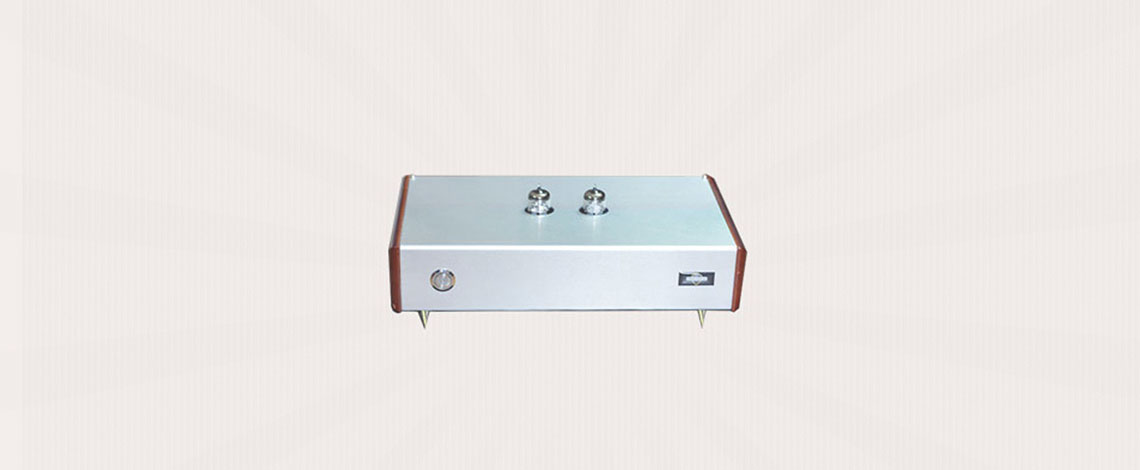
A box that does one thing: take zeros and ones off a hard drive and turn them into something a tube amplifier downstream can love.
The brief
By 2018 the vast majority of my listening had moved to high-resolution digital files — 24-bit at 96 kHz and above. The recording side of the industry had caught up: tracks were now being mastered at resolutions that exceeded CD redbook. But the playback chain hadn't kept pace. The bottleneck was no longer the file — it was what you did with the analog signal after the DAC.
The brief was to build a DAC whose downstream analog stage was good enough to deserve a 24/192 file.
Hybrid by design
The conversion itself is handled by a Cirrus Logic 192 kHz / 24-bit chip — a modern, well-engineered, well-supported piece of silicon that I had no interest in replacing. Solid-state is better at this job than any tube could be: the accuracy and the noise floor are simply beyond what valve circuitry can achieve.
But everything after the DAC is valve. The I/V stage, the buffer, the output. Vintage gold-pin Telefunken E88CC tubes — the German NOS stock, sourced carefully. The E88CC is a low-noise, low-microphonics double triode that is famously musical in the midrange; its harmonic signature is gentle, asymmetric, and non-fatiguing in long listening sessions.
That hybrid choice is deliberate. Digital gives you accuracy; tubes give you the harmonic envelope that makes music feel like music rather than a measurement.
The result
Transients arrive cleanly. The midrange has a roundness that you cannot fake with a solid-state output stage. The noise floor stays quiet. And the box plays nicely with any tube amplifier downstream — including the CB1070i, which is what I tuned it against.
There is a sentence I keep returning to about this build: the result cannot be explained in words unless experienced in person. That sounds like a marketing dodge. It is, however, accurate.