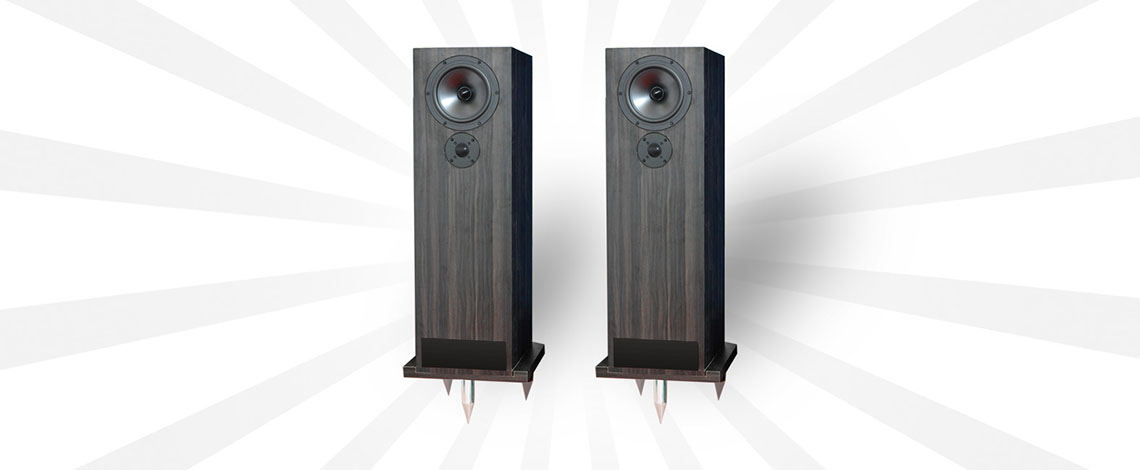
A speaker that gets out of the way of the music.
The problem with most speakers
Speakers do violence to phase and time. A sealed box rolls off low frequencies with a smooth slope but stops moving air the moment the cone's restoring force exceeds the input — bass disappears. A ported box gives you the bass back but adds a resonant peak, and that peak rings for milliseconds after every transient. You hear it as warmth on a guitar; you hear it as mud on a kick drum.
Most speaker design is a negotiation between which artefact you choose to live with.
Why transmission line
A transmission line routes the rear wave of the woofer down a long, damped tunnel. By the time it emerges, it has shed most of its energy into damping fibre and arrives in phase with the front wave at low frequencies. You get the LF extension of a ported design without the resonant overhang.
That's the easy explanation. The hard part is the tuning: line length, taper, and damping density all interact. Get any one of them wrong and you have a beautiful enclosure with mediocre bass.
The components
- Woofer: aluminium composite cone. The rigidity keeps motion pistonic up into the upper midrange, where most paper cones start breaking up.
- Tweeter: aluminium dome. Faster transient response than fabric. The trade-off is a brighter character; the crossover earns its keep by managing it.
- Crossover: German LCR components. Hand-wound air-core inductors with matched values. Air-core because iron-core inductors saturate at low frequencies and magnetically compress the signal — a subtle artefact that doesn't show up on most measurements but shows up immediately on string sustain.
- Enclosure: hand-crafted, line tuned to 23 Hz. Below most fundamental notes in music but exactly where you feel the bottom of a kick drum and the air in a hall.
Tuned live
The line and the crossover were tuned with REW (Room EQ Wizard) in the room they were built for. Spec-sheet tuning gets you close; in-room tuning gets you the last 20 % that separates a competent speaker from one that disappears.
The result
These are designed for studio reference and for long listening sessions. The phase distortion is low enough that the soundstage stops collapsing as you turn the volume up. The bandwidth is wide enough that you can listen to acoustic recordings and the speakers stop being in the room.