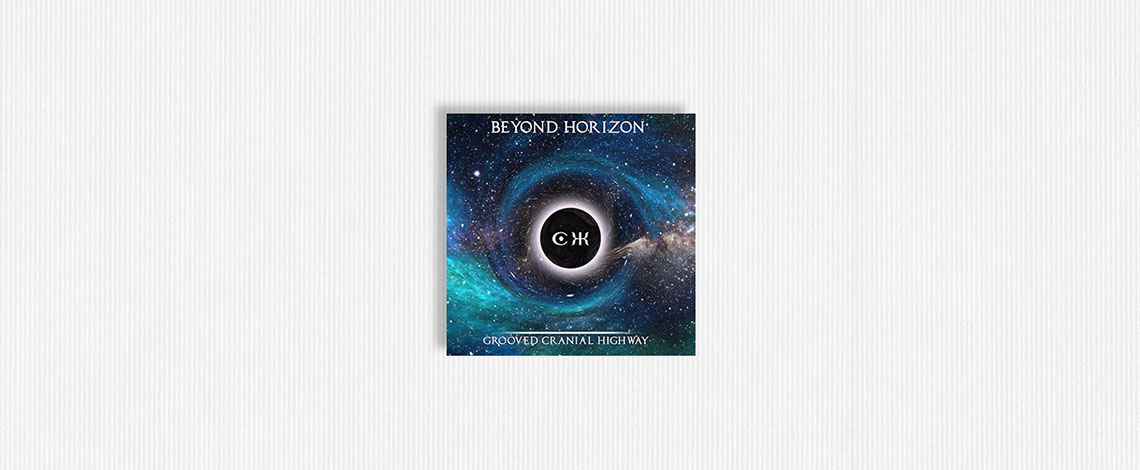
The hardest design briefs are the ones where the music has no lyrics — no narrative anchor for the listener to imagine alongside. The visual identity has to carry the philosophy on its own.
The artist
Grooved Cranial Highway is an instrumental psychedelic-rock project — the music I write and play with collaborators around an ongoing interest in theoretical physics and what it tells us about the limits of human meaning-making. The debut album is built around that idea.
The conceptual anchor
I chose the Schwarzschild radius as the visual anchor.
The Schwarzschild radius is the boundary around a sufficiently dense mass beyond which not even light can escape — the event horizon. Cross it, and the information about you stops being recoverable to anyone outside. It is a sharp, calculable boundary that contains the entire physical concept of a black hole.
It is also — and this is the part the project rests on — a clean metaphor for the threshold of meaning in human experience. There is a radius around a thought, a relationship, a memory, beyond which the original information is no longer recoverable. The Schwarzschild radius is what that boundary looks like in mathematics. The album is what it sounds like.
The visual language
The identity uses the geometry of the event horizon — circular boundary, gradient of falling light, type compressed against the edge of the singularity — as its core motif. The wordmark sits on the boundary; the album cover is the boundary; the system extensions push the same geometry through layouts, gig posters, social, packaging.
Stark, minimalist, scientific — the visual language matches the music's coldness without sacrificing its warmth.
What design at this scale teaches you
A band identity isn't a logo. It's a system of permission — this typeface, this geometry, this colour, this restraint — that lets you make a hundred future objects (posters, sleeves, drum-kit decals, lyric sheets, T-shirts, social cards) without any of them feeling out of family. That system has to be rigid at the centre and forgiving at the edges. Getting that ratio right is most of the work.